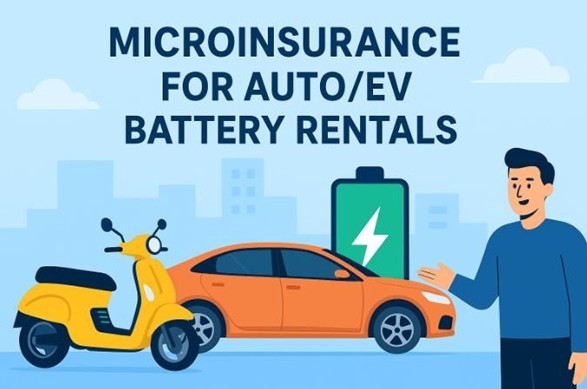
Protecting India’s Fast-Growing Electric Mobility Economy
Electric vehicles are often portrayed as cost-savers - no fuel expenses, lower running costs, and minimal maintenance. While this is true to an extent, most EV owners are unaware that a single battery replacement can cost 40–60% of the vehicle’s total value, wiping out years of savings. With average replacement costs ranging between ₹60,000 to ₹1.4 lakh for two-wheelers, ₹2–3 lakh for three-wheelers, and significantly higher for electric tractors and small commercial EVs, the financial risk can be overwhelming for low-income or small-business users. This is where microinsurance for EV batteries and battery rentals emerges as a crucial shield, ensuring that the very technology designed to save money does not become a financial burden.
The Rise of India’s EV Battery Rental Economy
India is one of the fastest-growing EV markets in the world. Key drivers behind this growth include:
- Cost savings on fuel
- Government incentives and subsidies
- Rapid expansion of EV charging and swapping ecosystems
- Growing adoption of Battery-as-a-Service (BaaS)
Battery rental and swapping models - pioneered by companies like SUN Mobility, Bounce Infinity, and Battery Smart - reduce upfront EV costs by 30–40%, making EVs accessible to delivery agents, gig workers, small logistics operators, and low-income commuters.
A similar trend is emerging in the electric tractor space, where startups are piloting batteryswappable tractors for farmers, reducing diesel expenses and lowering operational costs. This segment too will need tailored microinsurance as battery-related risks directly affect agricultural livelihoods.
However, with scale comes risk.
Why Microinsurance for EV Batteries?

EV battery failures, damage, theft, and performance degradation directly impact a user’s livelihood - especially for gig workers and MSMEs that rely on EVs for income.
Key Risks Faced:
- Physical damage from accidents or water ingress
- Thermal incidents (overheating, fires, short circuits)
- Theft/loss of battery packs
- Degradation affecting performance or range
- Rental battery misuse charges or penalties
- Unexpected repair/replacement costs
These challenges affect two-wheelers, three-wheelers, cargo loaders, and increasingly electric tractors, all of which contribute significantly to India’s livelihood ecosystem.
Without insurance, these risks translate into sudden, high out-of-pocket expenses, leading to financial instability especially for economically vulnerable populations.
How Microinsurance Can Transform the EV Ecosystem
1. Covers High-Cost Battery Damage or Replacement
Microinsurance can absorb unexpected repair or replacement expenses, ensuring users do not fall into debt or lose their income source.
2. Protects Battery Rental Companies
Battery-swapping operators face operational risks:
- Lost/stolen battery packs
- Inventory damage
- Misuse by riders
Insurance lowers their financial exposure and helps scale the swapping ecosystem
3. Supports Gig Workers and Small Businesses
Delivery riders and local transport operators depend on their EVs daily. Battery insurance ensures:
- No disruption of income
- Affordable claims processes
- Quick settlement using parametric or telematics-based triggers
4. Enhances Trust and Adoption in EV Markets
When users know that the most expensive component (the battery) is protected, adoption increases significantly.
5. Enables Data-Driven, Usage-Based Insurance Models
IoT-enabled batteries provide:
- Real-time health monitoring
- Battery lifecycle data
- Charging behaviour insights
This enables pay-as-you-use microinsurance - affordable and personalized.
What a Microinsurance Product for EV Battery Rentals Could Include Coverage Features
- Accidental damage
- Fire, explosion, or thermal incidents
- Waterlogging damage
- Theft or loss during rental use
- Battery degradation beyond a defined threshold
- Misuse protection for rental operators
- Liability coverage (optional)
- Daily income replacement for gig workers in case of breakdown
Value-Added Services
- Battery health diagnostics
- Free teleconsultation for vehicle issues
- Emergency roadside assistance
- Discounts on battery swap subscriptions
Why This Matters for India’s Climate and Financial Inclusion Goals
As India advances toward its EV30@30 target - 30% of all vehicles to be electric by 2030 - battery protection insurance becomes essential for:
- Reducing the financial vulnerability of low-income EV users
- Enabling sustainable mobility adoption
- Supporting green entrepreneurship in tier-2 and tier-3 cities
- Protecting climate investments from operational risks
Microinsurance ensures that the shift to clean transport is both affordable and secure for all.
Key Statistics Supporting EV Battery Microinsurance
- EV sales in India crossed 1.67 million units in FY 2023–24, growing 42% YoY. (Source: FADA)
- Battery costs make up 40–60% of an EV’s total price, making them the single largest financial risk. (Source: NITI Aayog – India EV Report)
- The Indian battery-swapping market is projected to grow at a CAGR of 35% by 2030, driven by adoption among delivery workers and shared mobility. (Source: IESA)
- EV two-wheeler battery replacement costs range from ₹60,000 to ₹1.4 lakh, often unaffordable for low-income users. (Source: JMK Research)
- A majority of gig workers earn below ₹25,000 per month, making large battery-related expenses financially devastating. (Source: NITI Aayog – Gig Economy Report)
These statistics highlight the urgent necessity for innovative microinsurance solutions tailored for EV mobility users.
Why Microinsurance Is Critical for the Next Billion Users
While insurers have begun introducing EV-specific covers - such as battery
protection, charger
insurance, and performance-linked warranties - these offerings still focus
heavily on urban,
formal, higher-income segments. This leaves out India's
Next
Billion Users:
delivery riders,
small fleet owners, farmers using electric tractors, migrant workers, and
low-income EV
adopters, many of whom depend on battery rentals or swapping to earn their
livelihood.
Their risk exposure is higher, but their ability to absorb battery-related expenses is extremely limited. Microinsurance provides the bridge - affordable, usage-based protection designed for underserved and vulnerable communities powering India’s EV revolution.
Conclusion: A New Age of Microinsurance Innovation
Microinsurance for Auto/EV Battery Rentals is not just a niche product - it is a critical financial safety net for India’s emerging electric mobility ecosystem. By protecting users, operators, and businesses from battery-related risks, it helps accelerate EV adoption while safeguarding livelihoods.
As India moves toward a cleaner, greener, and more inclusive mobility future, battery microinsurance will play a pivotal role in ensuring sustainability, affordability, and financial resilience for millions of underserved and unserved segments of society.
About MicroInsurance Innovation Hub Foundation
The MicroInsurance Innovation Hub (MIIH) Foundation aims to revolutionize the Microinsurance segment, especially in India and the Asia Pacific region. Based in Hyderabad, it focuses on developing inclusive insurance solutions tailored to underserved populations. By exploring product, technological, and process requirements, the hub supports interested companies in penetrating this market segment. With a mission to serve the underprivileged, it strives to enhance insurance penetration and foster inclusive growth.
The Hub would work to support the development of micro insurance in the Indian insurance industry through exploring various aspects of this business, the product range, the technological requirements, the process requirements, and the type of people required to enhance penetration. For more information write us at contact@microinsuranceinnovation.com
CTA
At the Microinsurance Innovation Hub Foundation, we work closely with associates to design and promote such innovative risk solutions. Reach out to us to learn how microinsurance can protect your business.
Write to us at contact@microinsuranceinnovation.com and explore more at www.microinsuranceinnovation.com
Disclaimer
The Microinsurance Innovation Hub (MIIH) Foundation is a Section 8 company and has members who intend to foster financial inclusion of underserved and unserved communities through providing Insurance. The innovation hub will act as an open platform to the stakeholders of microinsurance. This Hub will exclusively work in the Microinsurance / Inclusive Insurance space in India and other regions. The information provided here is gathered from various sources and Microinsurance Innovation Hub doesn’t validate any data. The information here are intended solely for internal discussion purposes.