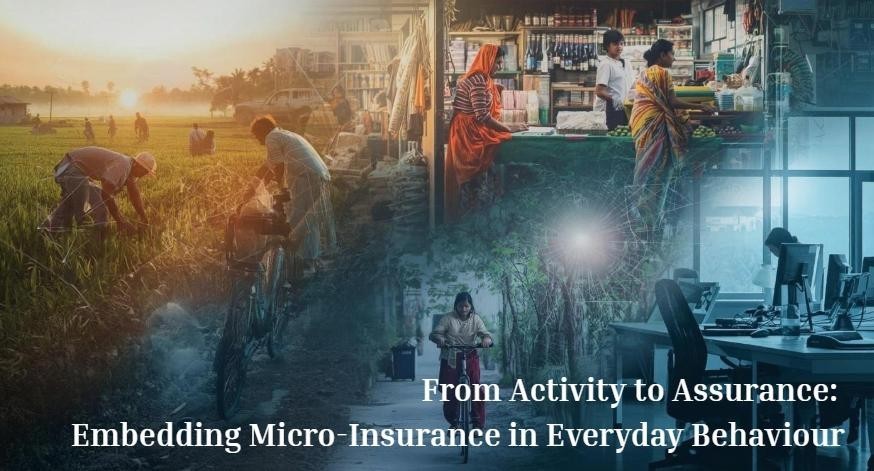
In an era of rising informal work, mobile connectivity and digital disruption, the traditional model of insurance - pre-paying a fixed premium for a period of time - may not always suit the needs of vulnerable, low-income, emerging consumers. At Microinsurance Innovation Hub, we believe there is a new frontier: micro-insurance that is triggered or embedded in everyday behaviour and activity, offering highly flexible, low-ticket protection aligned with the way people live and work.
Why this matters:
- There are ~ 4.7 billion “emerging consumers” (low-income or vulnerable people) who may be outside formal social protection systems. (microinsurancenetwork.org)
- In India, for example, a study found that micro-insurance penetration in rural areas is extremely low — an index of only ~0.04% of the rural population covered in 2022-23. (ResearchGate)
- Meanwhile, decisions, work patterns and livelihoods of such segments are increasingly driven by mobile usage, gig economy, informal assets and dailymoves rather than long-term contracts.
- Embedding insurance in behaviour means aligning protection with when risk occurs, when activity happens, and when people are willing to pay. It offers relevance, simplicity, and potentially higher uptake.
What do we mean by “Activity-Triggered Microinsurance”?
Rather than paying a premium for a year and hoping you make a claim, activity-triggered microinsurance links premium/policy/coverage to a specific user action or behaviour (or set of behaviours) and offers cover that is relevant for that moment. Some examples:
- A delivery rider activates cover only during his working hours or when his phone is used for deliveries.
- A device user (smart-phone, tablet) buys cover when they travel for 3 days — the premium is very low.
- A commuter pays a tiny premium for each metro ride (or each ride booked via an app) and gets accident/health cover for that trip.
- A gig-worker purchase correlates to insurance cover: e.g., every time a freelancer takes a job via a platform, a micro-premium is added and work-hours cover is available.
- Embedded in other services: an MNO or app gives “free” micro-insurance linked to usage, which then influences behaviour. For example, a study from Cote d’Ivoire of 3.5 million subscribers found that offering free embedded insurance led to a 20% increase in transaction count per month and a 24% increase in transaction value per month among those who opted in. (Default)
Why this product is still uncommon (and why it’s an opportunity)
- Most microinsurance still uses the “always-on” model: pay premium regularly, get life/health/asset risk cover. Adoption in informal sectors remains low.
- Activity-triggered cover requires behavioural data, digital platforms, real-time triggers, and often smaller, flexible premiums — not all insurers or markets have implemented this yet.
- Trust, awareness, administrative cost and regulatory frameworks still pose challenges in many emerging markets. (SuPublication)
- But this very gap is opportunity: for Microinsurance Innovation Hub to pioneer a product that is more relevant, frictionless and behaviour-linked for underserved segments.
Designing the Microinsurance Innovation Hub Product: “Work & Move MicroCover” Product Summary
- Target: Informal/gig workers, mobile device users, daily commuters in urban/ peri-urban India.
- Trigger: User performs a defined activity (e.g., logs into gig-platform and accepts first job, takes a ride via partner app, travels outside home area, uses mobile phone in delivery mode).
- Coverage: For the duration of that activity (e.g., job hours, ride hours),
the user gets:
- Accidental injury cover
- Loss/Damage of device (phone/tablet) if used in the activity
- Daily income replacement (small fixed amount) if activity interrupted by accident/injury
- Premium: Micro-premium (e.g., ₹ 10-₹ 30) per job/ride/usage, paid via app or embedded partner service.
- Distribution: Partner with gig platforms, delivery apps, mobility services, wallet/telecom partners — embedded purchase at time of booking or job acceptance.
- Digital-first: Activation, tracking, claims via mobile app; simple UI; minimal paperwork.
- Behavioural Incentives: Offer users lower premium or “bonus credits” if they log certain safe behaviours (e.g., device usage hours logged, safe driving mode on, use of protective gear, put phone in ‘work-mode’). Over time, this builds a personalised risk-profile and loyalty.
- Claim Trigger: Verified accident/injury via app and partner network; device damage/loss via registered device ID; income replacement via partner job-log verification.
- Impact Metrics: Uptake rate, claim frequency, reduction of downtime, increased earnings, client retention.
Why this matters – the potential impact

- Relevance: The product meets people exactly when they’re exposed to risk (at work, on the move) rather than requiring a large upfront premium.
- Affordability: Micro-premium means low barrier to entry for low-income segments.
- Behavioural change & loyalty: Embedding insurance in activity may lead to increased platform engagement, safer practices, device care, and higher earnings (as seen in embedded insurance study). (Default)
- Financial inclusion: We know microinsurance can contribute to economic resilience and growth. One study found that in African countries the marginal effect of microinsurance on economic growth is positive for lower-income economies. (MDPI)
- Scalability: Via digital platforms and partners, the delivery cost can be low, enabling high volume at low ticket premium. Real-World Signals and Statistics
- The embedded insurance market is booming: approx. 87% of embedded insurance products now run on API integrations for real-time offers; telematicsbased policies make up ~46% of auto embedded insurance in 2025 in one report. (CoinLaw)
- Research shows that offering insurance via embedded channels can drive behaviour change: the Cote d’Ivoire study mentioned earlier showed 20% increase in monthly transaction count and 24% in value among users who optedin for free embedded insurance. (Default)
- A systematic review found micro-health insurance in developing countries provided measurable financial risk protection for many households. (BioMed Central)
- According to a global microinsurance review: “only one in five” of emerging consumers (those 4.7 billion people) uses any insurance. (microinsurancenetwork.org)
Key Considerations & Challenges
- Data & Trigger Reliability: Ensuring the activity-trigger is verifiable and cannot be easily gamed or lead to high adverse selection. Telemetry/usage logs, partner APIs, device ID verification are critical.
- Customer Trust & Education: Low-income segments may distrust insurance; they need clear terms, transparent triggers, and prompt payouts. The microinsurance literature emphasises trust and governance. (SpringerLink)
- Pricing & Cost Efficiency: Micro-premiums mean margins are tiny; keeping operational and claims costs low is critical. Partnerships and digital distribution are vital.
- Regulatory Environment: Embedded and usage-based insurance may need regulatory clarity (especially regarding triggers, premium payment, distribution) in India.
- Behavioural Incentives vs. Moral Hazard: While embedding insurance encourages active usage, there’s risk of unsafe behaviour (e.g., taking more risky rides) if incentives are poorly designed.
- Sustainability & Scale: A high volume of small premiums is needed; partner ecosystem must support large scale for viability.
Why microinsurance industry should build this now:

- 1. Aligned with digital & gig economy trend: More workers are on
platforms, mobile devices are ubiquitous, making the delivery channel ripe.
- 2. High social impact: Protecting informal/gig workers, device-based
livelihoods and daily commuters addresses a large underserved segment.
- 3. Business opportunity: Embedded insurance via partners opens new
revenue streams and cross-selling opportunities.
- 4. Brand-differentiation: By offering innovative, behaviour-embedded
cover, one can stand out from traditional microinsurance and can build stronger
relationships with customers.
Our suggestion on the Next Steps:
- Pilot with a partner: Consider teaming up with a delivery-app, gig-platform or telecom wallet in a city (e.g., Hyderabad).
- Define the trigger(s): e.g., job start in platform, ride start, device-work mode start.
- Set up pricing: Micro-premium ₹ 20 per job/ride, user pays via app.
- Build claims workflow: Simple app upload, partner verification, payout to wallet/account within hours.
- Measure KPIs: Uptake %, claims frequency, job interruption Days saved, earnings protected, customer satisfaction.
- Market the product: Position as “When you’re working or moving, we’ve got you covered” — simple, mobile-first language, minimal paperwork.
- Monitor & scale: Once pilot is stable, scale to other cities/partners, adjust triggers/premium as needed.
In summary
Activity-triggered microinsurance offers a powerful combination of relevance, affordability and digital-first delivery. For vulnerable workers who earn daily or rely on devices and movement, this kind of cover is far more aligned with their real risk exposure than traditional models. With compelling evidence that embedded insurance can change behaviour and enhance engagement, Microinsurance Innovation Hub advocates the opportunity and the responsibility to design a product that truly resonates. Let’s move from pay-once-a-year to pay-when-you-move - and build resilience for the working billions.
Research & Citations Appendix
1. Emerging consumers (global low-income segments): 4.7 billion people
2. Microinsurance penetration in India’s rural areas: ~0.04%
3. Embedded insurance adoption impact:
- Cote d’Ivoire study: 20% increase in monthly transaction count; 24% in transaction value among users opted in for free embedded insurance
- Source: RGA Reinsurance – Does free embedded insurance impact behaviour?
4. Microinsurance effect on economic growth:
- Systematic review: positive marginal effect for lower-income economies
- Source: MDPI – Microinsurance and economic growth
5. Global microinsurance uptake: 1 in 5 emerging consumers use any insurance
- Source: Microinsurance Network
6. Operational challenges and trust:
About MicroInsurance Innovation Hub Foundation
The MicroInsurance Innovation Hub (MIIH) Foundation aims to revolutionize the Microinsurance segment, especially in India and the Asia Pacific region. Based in Hyderabad, it focuses on developing inclusive insurance solutions tailored to underserved populations. By exploring product, technological, and process requirements, the hub supports interested companies in penetrating this market segment. With a mission to serve the underprivileged, it strives to enhance insurance penetration and foster inclusive growth.
The Hub would work to support the development of micro insurance in the Indian insurance industry through exploring various aspects of this business, the product range, the technological requirements, the process requirements, and the type of people required to enhance penetration. For more information write us at contact@microinsuranceinnovation.com
CTA
At the Microinsurance Innovation Hub Foundation, we work closely with associates to design and promote such innovative risk solutions. Reach out to us to learn how microinsurance can protect your business.
Write to us at contact@microinsuranceinnovation.com and explore more at www.microinsuranceinnovation.com
Disclaimer
The Microinsurance Innovation Hub (MIIH) Foundation is a Section 8 company and has members who intend to foster financial inclusion of underserved and unserved communities through providing Insurance. The innovation hub will act as an open platform to the stakeholders of microinsurance. This Hub will exclusively work in the Microinsurance / Inclusive Insurance space in India and other regions. The information provided here is gathered from various sources and Microinsurance Innovation Hub doesn’t validate any data. The information here are intended solely for internal discussion purposes.